Why Local Businesses Need More Than a Website to Win in Search
A website matters. It is usually the first place a serious buyer goes when they want to check you out, compare your offer, or decide whether your business feels legitimate.
But a website by itself is not a complete marketing system. For a local business in Savannah, Pooler, Bluffton, Richmond Hill, or anywhere nearby, the real win happens when your website is connected to everything else that helps people find you, trust you, and take the next step.
Search is no longer just ten blue links
When someone searches for a local service, they may see a map pack, reviews, business profiles, ads, images, videos, AI summaries, directory results, social content, and traditional organic listings. Your website is part of that picture, but it is not the whole picture.
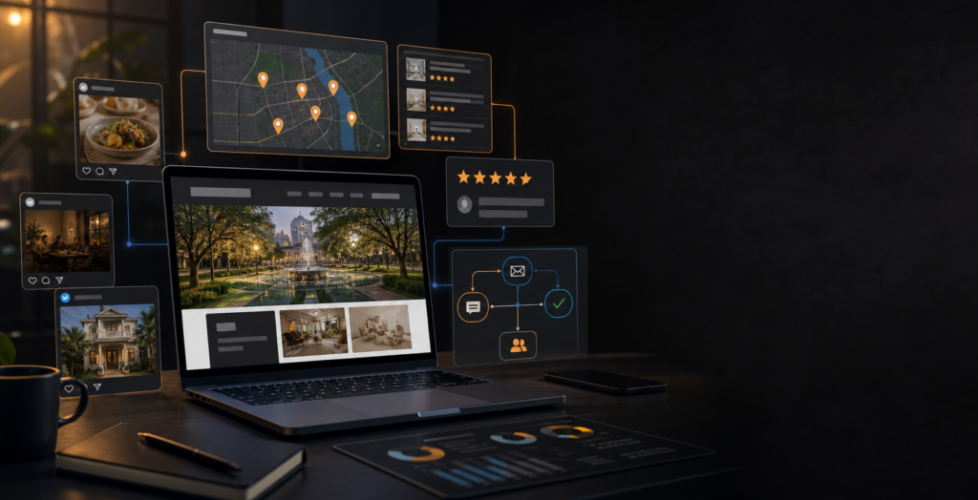
That means local visibility now depends on a connected set of signals: your service pages, location relevance, Google Business Profile, reviews, content, conversion tracking, and the follow-up system that turns a form fill or phone call into a booked conversation.
The website should be the center, not the whole machine
Your website should explain what you do, who you help, where you work, and why someone should choose you. It should also give Google clear pages to understand, crawl, and rank. That is why service-area pages, focused offer pages, and internal links matter.
But if the website is not supported by local search signals, it has to do too much heavy lifting by itself. A stronger approach is to treat the site as the center of a local marketing system.
- Local SEO helps search engines understand your services and service areas.
- Google Business Profile optimization helps you show up better in maps and local pack searches.
- Reviews and reputation signals help buyers trust you before they ever contact you.
- Video and social content make the business feel real, active, and easier to choose.
- Meta ads and retargeting keep your offer in front of people who are not ready the first time.
- Automation and CRM follow-up make sure good leads do not disappear after the first click.
Local SEO needs real service and location structure
One generic services page usually is not enough if you want to compete across multiple nearby markets. Someone looking for web design in Pooler is not searching the exact same way as someone looking for local SEO in Bluffton or Google Business Profile help in Richmond Hill.
That does not mean making thin copy-paste pages. It means building useful, focused pages that describe the service, the local context, the problems buyers are trying to solve, and the next step. Then those pages need to be connected with internal links so the whole site reinforces the same local authority.
That is the reason we built a dedicated local marketing services hub for Dawg Haus Creative. It gives visitors and search engines a clean path into local web design, SEO, video, Google Business Profile, Meta ads, automation, and related services by area.
Your Google Business Profile is a conversion surface
For many local searches, your Google Business Profile may be seen before your website. People can call, request directions, read reviews, look at photos, check hours, scan services, and compare you against competitors without clicking through first.
That profile should not be treated like a one-time listing. It needs accurate services, strong categories, fresh photos, review momentum, posts when appropriate, and website links that send people to the most relevant page instead of dumping everyone on the homepage.
Content and ads should support the same offer
A common mistake is running ads, posting content, and building web pages as separate projects. The message changes from place to place, the landing page does not match the ad, and the follow-up is unclear.
The better move is to make everything point toward the same business goal. If the offer is local SEO, then the page, profile, content, ad creative, form, thank-you message, and follow-up should all support that path. If the offer is a welcome video or a website redesign, the same rule applies.
The follow-up system is where a lot of money leaks out
Getting traffic is only step one. Local businesses lose leads when forms go unanswered, calls are missed, inquiries sit in inboxes, or nobody knows what happened after someone clicked an ad.
That is where automation, CRM setup, call tracking, lead routing, email follow-up, and simple reporting start to matter. The goal is not to make the business more complicated. The goal is to make the path from search to conversation easier to see and easier to manage.
What a practical local marketing system includes
For most local businesses, the foundation looks like this:
- A clear website with service pages, location relevance, and conversion paths.
- A Google Business Profile that is complete, current, and connected to the right pages.
- Reviews and reputation workflows that make trust easier to build.
- Content that shows the real business, the real offer, and the real results.
- Paid traffic only when the landing page and follow-up system are ready.
- Tracking that shows which channels are creating calls, forms, bookings, and sales conversations.
That is the difference between “we have a website” and “we have a marketing system.”
Start with the path buyers already take
If you are trying to improve local visibility, do not start by asking for one random tactic. Start by looking at the path a real buyer takes: search, compare, click, review, contact, follow-up, and book.
Then build the pieces that make that path easier. For some businesses, that starts with a better website. For others, it starts with local SEO, Google Business Profile cleanup, video, ads, or automation. The best answer depends on where the current system is leaking.
Dawg Haus Creative helps local businesses build those pieces into one connected system. Explore our local marketing services by area, or start with a focused service like local SEO in Savannah, Google Business Profile optimization, or Meta ads management.
Related local growth services
These related Dawg Haus Creative pages go deeper on the local service paths mentioned above.